Alexandria African American World War I Draft Registrations – Part 2: B

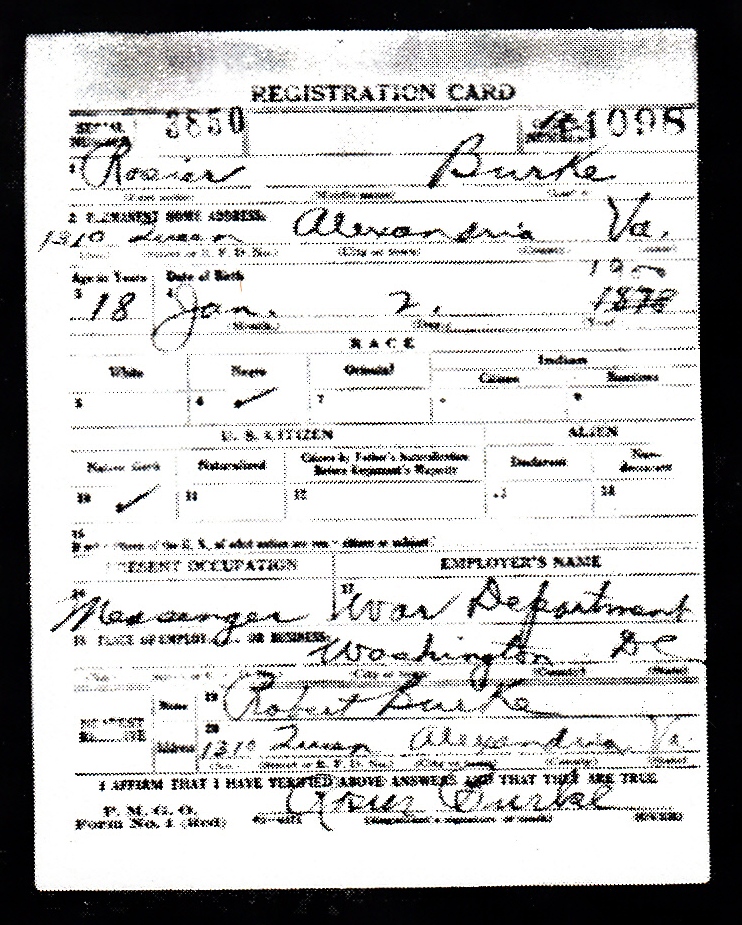
Roiser Burke
WWI Draft Registration Card of Rosier Burke

The Draft registration was an act called the “Selective Service Act (Selective Draft Act),” was enacted on May 18, 1917. That act authorized the Federal Government to create a National Army. Prior to WWI, the United States had a small military force compared to the European countries.

The Selected Service Draft Act required all males age 21 to 30 to register for military service. The War Department requested Congress to amend the age requirement and by September of 1918, the age was extended to all men from 18 to 45 years of age.

For African Americans who fell within this age group, the draft cards include genealogical information. Even better, if the individual served in World War I, their military records will provide their descendants a window into their lives. Many of the older African Americans born in the 1870s and prior to 1900 were probably the first or second generation from slavery. Their pension records might be the only information about their former enslaved parents. These records are a gold mine for their descendants.

Displayed below are the African American Alexandrians with the “B” surnames.

Baker, Gilbert – born April 20, 1893
Baker, James – born August 9, 1877
Baker, James Walter – born December 22, 1882
Baker, Lawrence – born March 12, 1888
Baker, Robert Curtis – born January 20, 1888
Ball, James A. – born March 31, 1887
Ball, Thomas H – born March 17, 1892
Ballard, Eugene – born April 2, 1885
Baltimore, Charles – born April 15, 1892
Baltimore, Leon C – born February 6, 1889
Baltimore, Preston S. – born March 23, 1892
Banks, Abe – born November 28, 1892
Banks, Edward J. – born February 7, 1890
Banks, Harry James – born July 2, 1899
Banks, James Henry – born August 1, 1873
Banks, Rufus McKinley – born November 26, 1896
Barber (Barbour), Samuel – born December 24, 1882
Barbour, Mathew – born February 4, 1880
Barksdale, Hanes – born June 15, 1894
Barrett, Howard Ashby – born September 8, 1882
Barrier, Fred Pelham – born September 12, 1878
Bates, Henry – born May 10, 1879
Bates, Randall – born February 26, 1885
Beach, Charles – born December 25, 1899
Beale, Moses – born February 22, 1893
Beander, William H. – born November 13, 1886
Beckham, Addison – born April 3, 1893
Beckham, Water Binton – born November 5, 1890
Belk, Thurlow Roy – born February 1, 1890
Belk, Charles Henry – born July 16, 1900
Bell, George – born January 1, 1884
Bell, Howard – born in 1896
Bell, James Edward – born March 17, 1879
Bell, Lewis – born February 4, 1898
Bell, Seabron – born September 20, 1885
Bell, Thomas – born April 18, 1880
Bell, Ulysses Garnett – born August 20, 1888
Bell, William Henry – born May 21, 1879
Belt, James Horace – born May 8, 1873
Bembery, John – born September 15, 1874
Bentley, Louis Laurence – born June 5, 1897
Bentley, Madison Clayton – born September 27, 1890
Bentley, Raymond Asa – born August 25, 1883
Berkley, Henry Strother – born September 18, 1879
Berry, Edward – born October 17, 1894
Beverley, Dan – born August 24, 1886
Beverley, Ernest – born April 16, 1880
Blackburn, John – born September 15, 1893
Blackwell, Walter – born June 2, 1892
Blake, Walter – born September 18, 1872
Blondheim, John – born September 20, 1890
Blue, James Nathaniel – born February 17, 1897
Blue, Randolph Benisford – born June 29, 1885
Bohanan, Robert Henry – born July 7, 1897
Bolden, Lawrence – born May 11, 1894
Bolden, Samuel – born April 27, 1893
Boswell, Maurice Henry – born February 6, 1893
Boswell, Otto – born September 11, 1896
Bouden, James Alex – born June 2, 1899
Bouden, Russia Sterling – born December 25, 1889
Bowen, Austin – born June 26, 1889
Bowen, Clarence C – born February 27, 1893
Bowman, John William – born December 22, 1978
Bowman, Richard Henry – born December 6, 1880
Boyd, Charles – born September 20, 1895
Boyd, Joseph – born July 24, 1899
Boyd, Julian Ashton – born March 22, 1890
Brabson, James Sydney – born October 7, 1899
Bradshaw, Edward – born in 1881
Branch, Charlie – born June 7, 1881
Brandon, David C – born May 16, 1892
Bratten, William Thomas – born January 21, 1883
Braxton, William McLindsey – born November 4, 1876
Breckenridge, John Henry – born September 10, 1897
Breisford, Charles – born June 1, 1897
Brent, Edward – born July 15, 1887
Brice, Boise – born in 1897
Brice, Edward – born August 3, 1873
Briggs, Howard – born in 1885
Broadus, Charles – born October 1, 1887
Broadus, Ulysses – born December 3, 1885
Broders, Marion – born April 2, 1880
Broders, Richard Edward – born April 5, 1875
Brooks, Benjaman – born July 2, 1876
Brooks, Frank Z – born August 1, 1879
Brooks, George Seldon – born May 12, 1896
Brooks, Lincoln Griffin – born June 9, 1878
Brooks, Richard Henry – born February 28, 1880
Brooks, Summerfield – born January 6, 1892
Brooks, William – born June 16, 1890
Brown, Aaron – born in 1890
Brown, Alexander Stanley – born September 24, 1891
Brown, Bud – born in 1879
Brown, Earnest – born August 1899
Brown, Frank – born April 9, 1888
Brown, George – born November 14, 1896
Brown, James H – born December 16, 1893
Brown, Joseph Edward – born May 13, 1899
Brown, Louis – born June 6, 1893
Brown, Maten – born March 2, 1897
Brown, Riley – born January 1, 1890
Brown, Thomas – born May 10, 1882
Bryant, Edward – born December 14, 1876
Bryant, Robert Champ – born November 5, 1881
Bryant, William Henry – born March 27, 1873
Buckner, Henry – born January 1, 1891
Buckner, William Isaac – born September 29, 1873
Buggie, William James – born July 4, 1887
Burgess, Albert – born April 15, 1892
Burgess, Pearl Albert – born September 9, 1890
Burgin, Edward – born August 15, 1897
Burke, Boyd – born October 5, 1883
Burke, Hugh – born September 2, 1880
Burke, Robert – born March 1, 1874
Burke, Robert Jr. – born May 30, 1898
Burke, Rosier – born January 2, 1900
Burr, Louis – born March 23, 1885
Burrell, Charles – born August 16, 1895
Burrell, John Thomas – born March 25, 1883
Burton, Albert – born March 20, 1881
Burton, Arthur – born May 1, 1873
Butler, Emmett – born April 18, 1882
Butler, George – born April 1, 1897
Butler, Isaac – born February 5, 1883
Butler, Junius – born May 9, 1900
Butler, John Lee – born April 23, 1900
Butler, John Matthew – born July 30, 1891
Butler, Lawrence – born June 18, 1886
Butler, Robert – born in 1899
Butler, Robert Henry – born December 19, 1897
Butler, Walter A – born September 6, 1888
Byrd, Charlie Henry – born June 8, 1900
Byrd, Henry – born December 27, 1891
Byrd, James W – born January 1, 1896
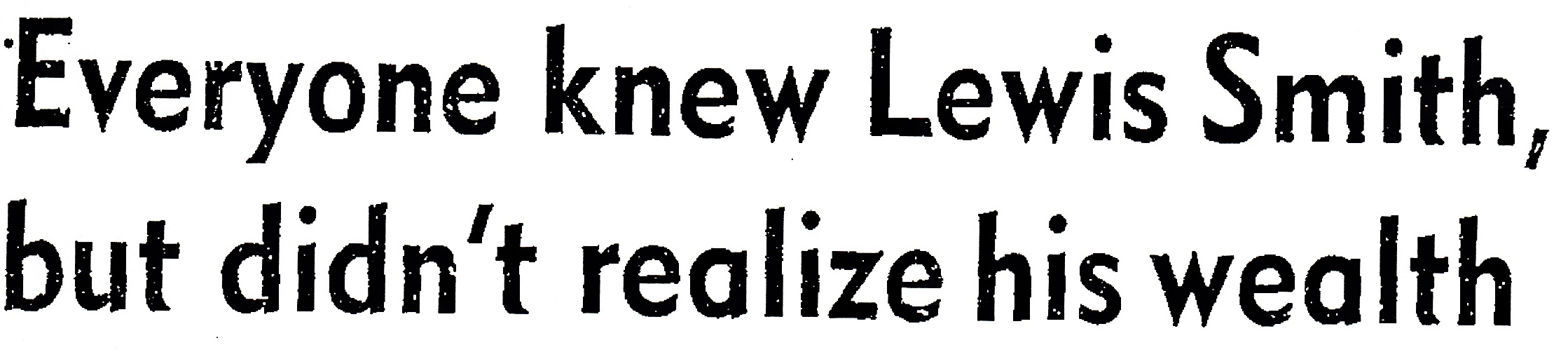
Lewis Smith, An Unlikely Wealthy Man

The Baltimore Afro-American Newspaper Article dated August 27, 1955

Mr. Lewis Smith deceived many people in Alexandria concerning his status in society. A newspaper article dated August 27, 1955, after the death of Mr. Smith, described him as an elderly man who drove his horse wagon up and down the streets of Alexandria. Lewis was much of a landmark as the Masonic Temple that overlooked the Potomac River.

Up until six years prior to his death, he was seen wearing worn out old clothes with patches on them and a battered hat. He hauled articles about town in his old wagon. Since the beginning of the 20th Century (1900), Mr. Smith owned a hauling business until 1949 when his old horse died.

Mr. Smith was 87-years old when he died in 1955. After his death, people found out that he was one of the wealthiest African American men in Alexandria, VA. His bank account totaled nearly $100,000. He had a large amount of real estate; he owned properties at 211, 213, 215, 217, 223 and 225 North West Street. He also owned 205½ and 214 North Payne Street, and 1311 Cameron Street. Mr. Smith received 211, 213 and 215 North West Street from his family. He purchased the rest of the properties.

Lewis Smith was born in 1870 in Alexandria, Virginia. His parents were Henry and Henrietta Hall Smith. Lewis’ father came to Alexandria in 1863 from Caroline County, Virginia, and his mother was from Augusta County, Virginia.

Lewis was married to Laura A. Webster. Webster’s people were freed people of color prior to 1865. Laura preceded Lewis in death by 50 plus years.

Lewis and his wife’s family made an impact on the African American history in Alexandria. Lewis’ father had a carriage business and he was a wagon driver. His father purchased several pieces of real estate in his lifetime. In addition, Lewis’ parents lost a child in 1866 named Alfred Smith. That child was buried at the Historical site of the Freedmen Cemetery.

Lewis assumed his father’s role, by having a business as a wagon hauler. He did better than his father in real estate and personal wealth.

Lewis’ wife was from free people of color prior to 1865. His wife, Laura’s parents were Oliver E. and Laura A Dundas Webster. Her father was a carpenter. Also Laura A Dundas was the cousin of Sarah A. Gray, principal of Hallowell School for girls from 1871 – 1890s.

Lewis and his wife Laura have many descendants; some of them are Mr. Harry Burke of (Alexandria, VA), Mr. Roland Burke of (Michigan), Mrs. Dorothy Hughes (Alexandria, VA), Ms. Mary Morris (Centreville, VA) and many others.

At the time of Mr. Lewis Smith’s death in 1955, one of the oldest black lawyers in Alexandria, Virginia, Mr. A.H. Collins said,

“Lewis Smith was an unusual man. When I came to Alexandria in 1920 from Norfolk, he moved my things from the boat dock to my first office. And, every time I moved, he moved me. He sent me plenty of business over the years, but I never handled any of his personal affairs. He used a big law firm in the downtown area to take care of his legal affairs. Some folks say that he lived for himself. ‘That isn’t true.’ He lived to save. He seemed to get a kick out of saving money.”

Update – City of Alexandria, VA Public Hearing on Contrabands & Freedmen’s Cemetery

This post is an update for Contrabands and Freedmen’s Cemetery descendants, Alexandria residents, and the public about new developments regarding the cemetery site. Located at 1001 S. Washington St, the Contrabands and Freedmen’s Cemetery is the burial ground for more than 1,700 “contraband of war.” “Contrabands” was a term used for enslaved Africans seeking protection and freedom behind the Union Defenses in Alexandria during the Civil War.

Many of the enslaved men, women and children who made the arduous journey to Alexandria were eventually buried on this site – a site later desecrated by a gas station and an office building. In 2007, the City of Alexandria reclaimed the land, and in 2013, a cemetery memorial to Alexandria’s Contrabands and Freedmen will open on this site.

The Alexandria City Council would appreciate hearing from the descendants of those buried in the cemetery, and residents interested in Alexandria’s contraband history, as they move forward in naming this historic landmark. In the coming weeks, City Council discussions and a public hearing will be held about the formal name for the Cemetery memorial. The name currently used is “Contrabands and Freedmen’s Cemetery Memorial”; however, the official name for the site has not yet been determined.
City Council wants to know your opinion about the use of the historic terms “contrabands” and “freedmens.” Your comments will assist Council as they determine the name for this landmark.

• Why Contrabands? This is a military term used during the Civil War. Contraband status was used to protect enslaved Africans who sought protection from the Union. By making enslaved Africans “contraband of war,” they could be protected and used to aid the Union cause. Enslaved Africans who were “contraband of war,” were considered property, and as such could not be returned to their masters. The use of “contraband” was not meant to be derogatory, but to reflect the transitory status of those seeking protection from Union forces.

• Why Freedmen? This term refers to African Americans before and after the Civil War. It indicates their status as free people. This term was in use before the Emancipation Proclamation in 1863, but became a widely used word in the American lexicon with the 1865 creation of the Freedmen’s Bureau. In the 19th century, the terms “contraband” and “freedmen” were often used interchangeably.

These historic terms are part of our Nation’s “contraband heritage.” Please let the City Council know your views about their use as part of the name for the future memorial.

Comments may be emailed to Dr. Pamela Cressey, Director, City Archaeology, at pamela.cressey@alexandriava.gov. You may also want to attend one of the meetings listed below, and share your thoughts. Help the Alexandria make history, and preserve an important part of our city’s Civil War story.

Public Meetings and Events:
• Tuesday, May 22: Introduction of Contrabands and Freedmen’s Cemetery Docket Item, Alexandria City Council Legislative meeting, 7 p.m., City Hall, 301 King St.
• Saturday, June 16: Alexandria City Council Public Hearing (public comment is invited), 7 p.m. – City Hall.
• Saturday, July 7: Groundbreaking Ceremony, Contrabands and Freedmen’s Cemetery site, 1001 S. Washington St., 9 a.m.

Alexandria, VA Esther Chapter #23

Esther Chapter #23
Alexandria, VA Esther Chapter #23 of Prince Hall Mason

Alexandria, Virginia has many African American Civic Organizations. One of the organizations that was established by 20 African American women, was the Esther Chapter of the Prince Hall Mason.

Members of the Grand Chapter of the State of Virginia, Prince Hall, the Alexandria Chapter, became the Order of the Eastern Star on November 26, 1908.

Grand Worthy Patron, Dr. H.L. Harris of Petersburg, Virginia and several others accepted the Alexandria Chapter under the name of Esther Chapter No. 23.

Since 1908, Esther Chapter No. 23 has hosted the Grand Chapter Annual Conference of the State of Virginia six times.
For one hundred and four years, the Esther Chapter No. 23 has served the Alexandria, Virginia community. The present Worthy Matron is Deborah Ford Nelson. From 1909 to 1966, there have been 40 Worthy Matrons.

Clara Lucas – 1909-1923
Katie Jackson – 1923-1924
Bessie Moore – 1924-1924
Katie Franklin – 1925–1926
Laura Dorsey – 1926–1927
Mary Redd – 1927–1928
Carrie Burrell – 1928–1929
Mary Dorsey – 1929–1930
Elnora Littlejohn – 1930-1932
Benjie V. Burke – 1932–1933
Catherine Holland – 1933–1934
Mazie Bouldin – 1934–1935
Emma Simmons – 1935–1936
Etta P. (B. Robinson) – 1936–1937
Lucy Washington – 1937–1938
Cora Henry – 1938 – 1939
Fannie Tucker – 1939-1940
B.M. Kemies – 1940-1941
Evelyn Brooks – 1941-1942
Esther Neal – 1942-1943
Fedora Lucy – 1943-1944
Marie Bowden (Gale) – 1944-1945
Ruth H. Wright – 1945-1946
Irene Terrell – 1946-1947
Bessie Barbour (Reynolds) – 1947-1949
Henrietta Jones (Stone) – 1949-1950
Ethel McCollough – 1950-1951
Virginia Ray – 1951-1952
Margaret Coleman – 1952-1953
Mary E. Burke – 1953-1954
Pearl Gibson – 1954-1955
Bertha Brown – 1955-1956
Emma Holland – 1956-1957
Eva W. Ladrey – 1957-1958
Julia Ratiff – 1958-1959
Mable Price – 1959-1962
Ida Hill – 1962-1963
Florine A. Grayson – 1963-1964
Collia Rivers – 1964-1965
Isabelle F. Poindexter – 1965-1966

Ms. Debbie Ford Nelson provided information on the Esther Chapter No. 23 for this blog. This blog only records the history of African Americans in Alexandria from 1865 – 1965. If you are interested in the Worthy Matrons from 1966 – 2012, please e-mail me and I will forward that e-mail to the present Worthy Matron, Debbie Ford Nelson.