Alexandria, VA’s Library Oral History Interviews

Alexandria, VA’s Barrett Library

The Alexandria Library Local History and Special Collection released seventeen short oral history interviews. These interviews were conducted with some of the oldest African American families, who share a small piece of their history of growing up in Alexandria. The oldest person interviewed was around 95 years old. Below are the links to sixteen of those interviews.

Alvin Lewis, a native-born Alexandrian, was interviewed by the Alexandria Library, Local History, and Special Collection about his family in Alexandria. You can view his interview at: https://www.youtube.com/watch?v=OfYs0eH86QA

===

The Alexandria Library, Local History, and Special Collection released Charles Sias’ oral history interview, and it is about his life in Alexandria. His family migrated to Alexandria from Mississippi in the 1950s. He attended and graduated from Parker-Gray High School. Check out his interview at https://www.youtube.com/watch?v=O-89dmfBgOk

===

Lesa Diggs-Moore’s oral history interview. She grew up in the Del Ray Community. She shares her childhood stories from the 1960s, when she dealt with the flooded areas in Del Ray. Check out her interview at https://www.youtube.com/watch?v=flW1zy0HSuU

===

Obie Lovelace’s oral history interview. The interview is about his life growing up in Alexandria. Check out his interview at: https://www.youtube.com/watch?v=3JYWZDMikXQ

===

Carolyn Banks Summers’ oral history interview. Her family made huge contributions to the Alexandria Black Business community. Check out her interview at:

===

Dr. Michael Casey’s oral history interview. His family history goes back to the 1700s in Alexandria/Fairfax, VA. Check out his interview at:

===

Ella Louise Joe’s oral history interview. She grew up in the Bailey Cross and Seminary Communities. Check out her interview at:

===

Michael A. Thomas’ oral history interview. Thomas grew up in Old Town Alexandria and attended Charles Houston Elementary School, Parker-Gray Middle School, and T.C. Williams. Check out his interview at: https://www.youtube.com/watch?v=SiyMBwMyYCw

===

Debra Adkins Cole grew up in Alexandria. In 1967, she was the first African American child to use the Alexandria Barrett Library. Debra discusses being part of the class of Titians in 1971 and 1972 at T.C. Williams. Check out her interview at:

===

Gerald Wanzer’s oral history interview. He grew up in the West End of Alexandria, VA, known as Seminary. His family has been in that area since the Civil War. Check out his interview at: https://www.youtube.com/watch?v=A3u1DEPybME

===                                                       

Clyde Pearson Jr.’s oral history interview. He grew up in Alexandria on West Street. He talks about going to the Catholic School. Clyde grew up during the period of segregation. He also talks about how African Americans cared for each other during his adolescent years in Alexandria. You can check out his interview at: https://www.youtube.com/watch?v=lFoASgoME-c

===

Harriet Payne Moore’s oral history interview. She was born in Alexandria in 1934. Moore grew up in the 500 block of Gibbon Street. She is a member of Roberts Memorial United Methodist Church. You can check out her interview at:

===

Willie Seegars’ interview. He was born in Alexandria and grew up on Pendelton Street. You can check out his interview at: https://www.youtube.com/watch?v=9LaXTHmbCtQ

===

Andrew Winfree’s oral interview. He is 87 years old and a 1955 graduate of Parker-Gray High School. He talks about his life in Alexandria, military, and work career. You can check out his interview at: https://www.youtube.com/watch?v=mB2RG38krRQ

===

Constance Yvonne Terrell’s oral history interview. She is 90 years old and a graduate of Dunbar High School in Washington, DC. She was born and raised in Seminary. Yvonne is a member of Oakland Baptist Church. You can check out her interview at: https://www.youtube.com/watch?v=4apGy3AunjE

===

Gwen Day Fuller’s oral history interview. Gwen is the daughter of the late Ferdinand T. Day. She talks about growing up on the North side of Alexandria. During her childhood, Gwen also talks about St. Joseph’s Catholic Church and Alexandria’s African American businesses. You can check out her interview at: https://www.youtube.com/watch?v=VvxCoELWJ8Q

Behind the Scenes of The Bell Family

Freida Bell Brockington

In 2023, the Alexandria Library, Special Collection, and Local History hosted the first Alexandria African American Family Reunion. This event focused on increasing the library’s collection of pictures and artifacts of African Americans who once lived or are still living in Alexandria.

Many people contributed pictures at that event, and even a family Bible was given to the library. Through the collection of photographs, I met Freida Bell Brockington.

She donated pictures from her family, including pictures of her father. In a conversation with Freida, she told me that her father worked for the government but was also a photographer. I only knew one early well-known African American photographer who took pictures in Alexandria during the 1930s—1970s, Elrich W. Murphy.

Freida’s story stayed with me. I felt that her family history was a part of Alexandria’s history and needed to be told. An opportunity came to tell her story when I came across a 1922 article about a man who died in Alexandria delivering supplies for the Masonic Temple. This man’s name was John S. Bell. I called Freida and asked her whether she had a story in her family about the Masonic Temple. Immediately, she told me that her great-grandfather had something to do with the Masonic Temple. In addition, she told me that the last three generations on her paternal side were named John Bell, and each John had a different middle name and used their middle name as an initial. There was John J. Bell, her father; John A. Bell, her grandfather; and John S. Bell, her great-grandfather. That was enough information for me to research.

I researched Freida’s great-grandfather, John S. Bell, back to Winchester, VA. Her second great-grandfather, John Bell, was born in Winchester, VA, in 1845 and was listed on the 1860 Census as a free boy at 15. He was living in the household of his mother, Catharine Bell. There were also other children in the household besides John. These children were Emily, age 17; Martha, age 6; Queen, age 4; and Mary, age 1. They were John’s siblings.

If it weren’t for Freida’s participation in the Alexandria African American Family Reunion, where she donated pictures to the library, I would have never known she was connected to a man who took part in building the Alexandria Masonic Temple.

The 2025 Alexandria African American Family Reunion will be on September 6, 2025, at the Alexandria Barrett Library on Queen Street. Please attend and donate copies of your family’s pictures. It just might be a researcher like me who uncovers your family history.

On February 27, 2025, check out the second blog posting of the Bell family with an interview with John A. Bell’s grandson, Andrew “Andy” Evans.

Please read the Alexandria Gazette Newspaper titled, “The Ringing Success of the Bell Family: “A family’s historical connection to Alexandria and the Masonic Temple.” The article is on page 3, https://connectionarchives.com/PDF/2025/020525/Alexandria.pdf

“Importance of Knowing Your History”

The City of Alexandria, Virginia, celebrated the 10th Anniversary of the Freedmen’s Cemetery and its Descendants in a three-day celebration that started on September 6, 2024.

From 2008 to 2014, the City’s Genealogist researched and located descendants of the Freedmen Cemetery. In 2014, the City dedicated the Freedmen Cemetery Memorial, and hundreds of people, along with National Television coverage, brought National recognition to this Cemetery. Before the celebration, many descendants had no clue about their family history related to the Civil War.

Through research, the City gave the descendants a part of their history that they never knew. After they received the news that their family was buried at the Cemetery and that they had arrived in Alexandria after running away from enslavement, they cried as they processed the information. But once they went through that process, their shoulders became straighter, and they knew their ancestors’ strength and determination of wanting freedom at any cost.

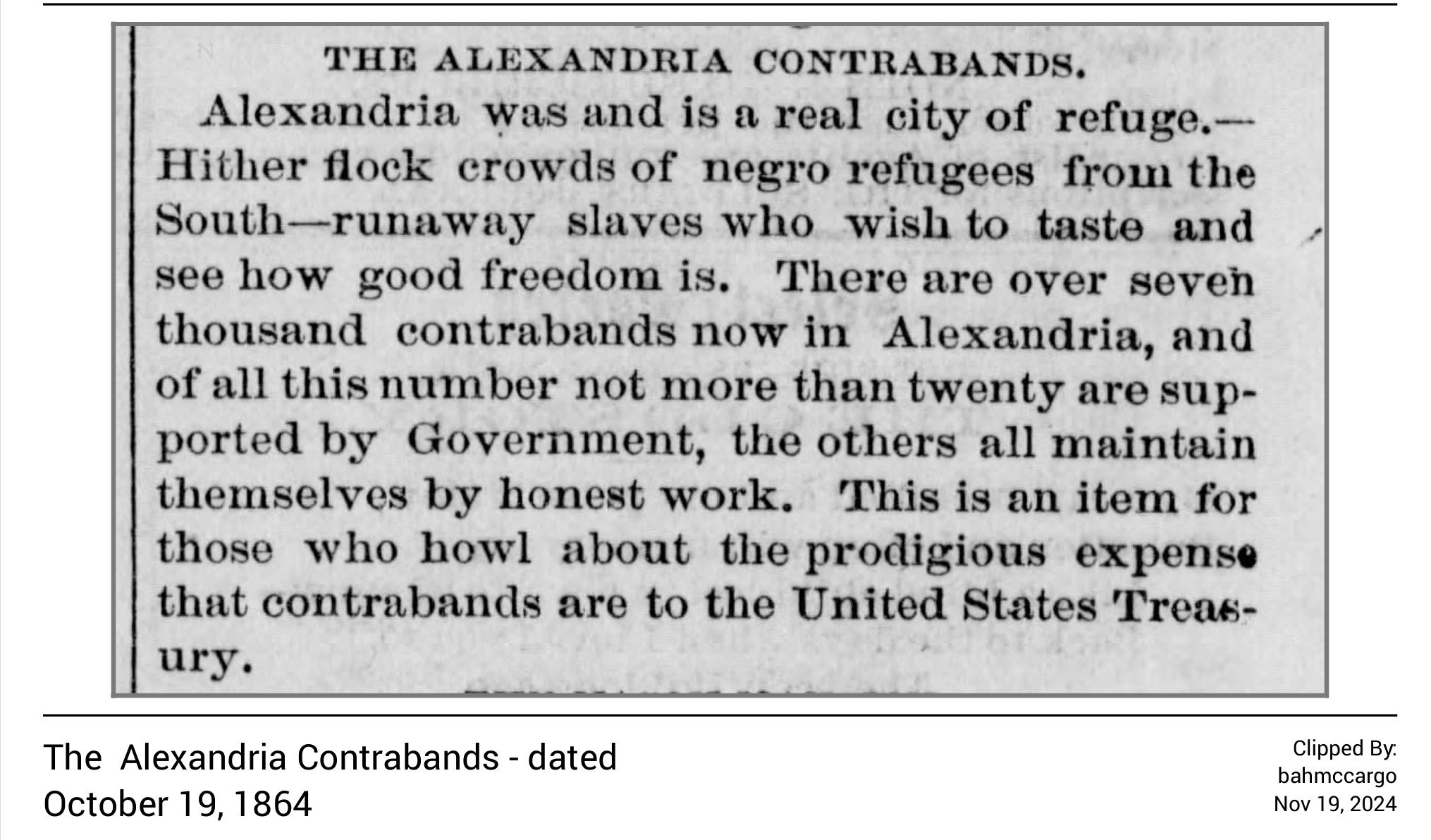
Just like their ancestors, who came to Alexandria for Freedom, Alexandria invited their descendants back to honor their ancestors’ Freedom. But what was the back story of their ancestors? The article on this page, which was published in the “Soldiers’ Journal,” stated that over seven thousand runaway slaves who were called contrabands wanted to taste freedom. They were hardworking people who wanted the same things that other free people had freedom.  

In my book, “Alexandria’s Freedmen’s Cemetery: A Legacy of Freedom,” on page 77, I discuss a child, John Gaines, who was buried at the Freedmen Cemetery in 1864.

“In 1864, the month of July was extremely dry, with the water levels low, grass growing in the reservoir, the temperature very sultry and mosquitoes abounding. During this extremely hot weather, eight-year-old John Gaines was buried on July 28, 1864.”

John Gaines’ parents were among the seven thousand people mentioned in the article who came to Alexandria for Freedom. His descendants, Lillian Locklear Alston and Wanda Ellis took part in the 2014 Freedmen’s Cemetery Memorial Celebration, along with several hundred other descendants of people buried at the Freedmen’s Cemetery.

Everybody’s history is essential; we are the only living thing celebrating our past. If we do not study ourselves or create a study guide of our history and how we came about, then who else will focus on us? For the descendants of the Freedmen Cemetery, they had Alexandria, who gave them the most precious thing a human being can have, which is a piece of their history!

If you want to read additional stories and learn more about the Freedmen Cemetery, you can find the book, “Alexandria’s Freedmen’s Cemetery: A Legacy of Freedom,” by Char McCargo Bah at amazon.com. Also, you can visit Alexandria and stop by the Freedmen Cemetery and the Alexandria Black History Museum.

©2024-Char McCargo Bah

The Other Alexandria: A 160-year-old Road Map

Annie Lee Wheeler’s death certificate

Many people came to Alexandria during the civil war from Maryland, North Carolina and other parts of Virginia. Few African American families talked to their children about their lives prior to the civil war. These stories were lost and never passed down through the generations. However, one of these families who migrated to Alexandria during the civil war did share their family history with their younger generation.

Annie Lee Wheeler shared her father’s family history with her daughter, Helena Wheeler and her grandchildren, especially her granddaughter, Shirley Gilliam Sanders Steele.

Check out their story in the Alexandria Times’ newspaper dated April 14, 2022, at https://alextimes.com/2022/04/the-other-alexandria-steele/.