“Importance of Knowing Your History”

The City of Alexandria, Virginia, celebrated the 10th Anniversary of the Freedmen’s Cemetery and its Descendants in a three-day celebration that started on September 6, 2024.

From 2008 to 2014, the City’s Genealogist researched and located descendants of the Freedmen Cemetery. In 2014, the City dedicated the Freedmen Cemetery Memorial, and hundreds of people, along with National Television coverage, brought National recognition to this Cemetery. Before the celebration, many descendants had no clue about their family history related to the Civil War.

Through research, the City gave the descendants a part of their history that they never knew. After they received the news that their family was buried at the Cemetery and that they had arrived in Alexandria after running away from enslavement, they cried as they processed the information. But once they went through that process, their shoulders became straighter, and they knew their ancestors’ strength and determination of wanting freedom at any cost.

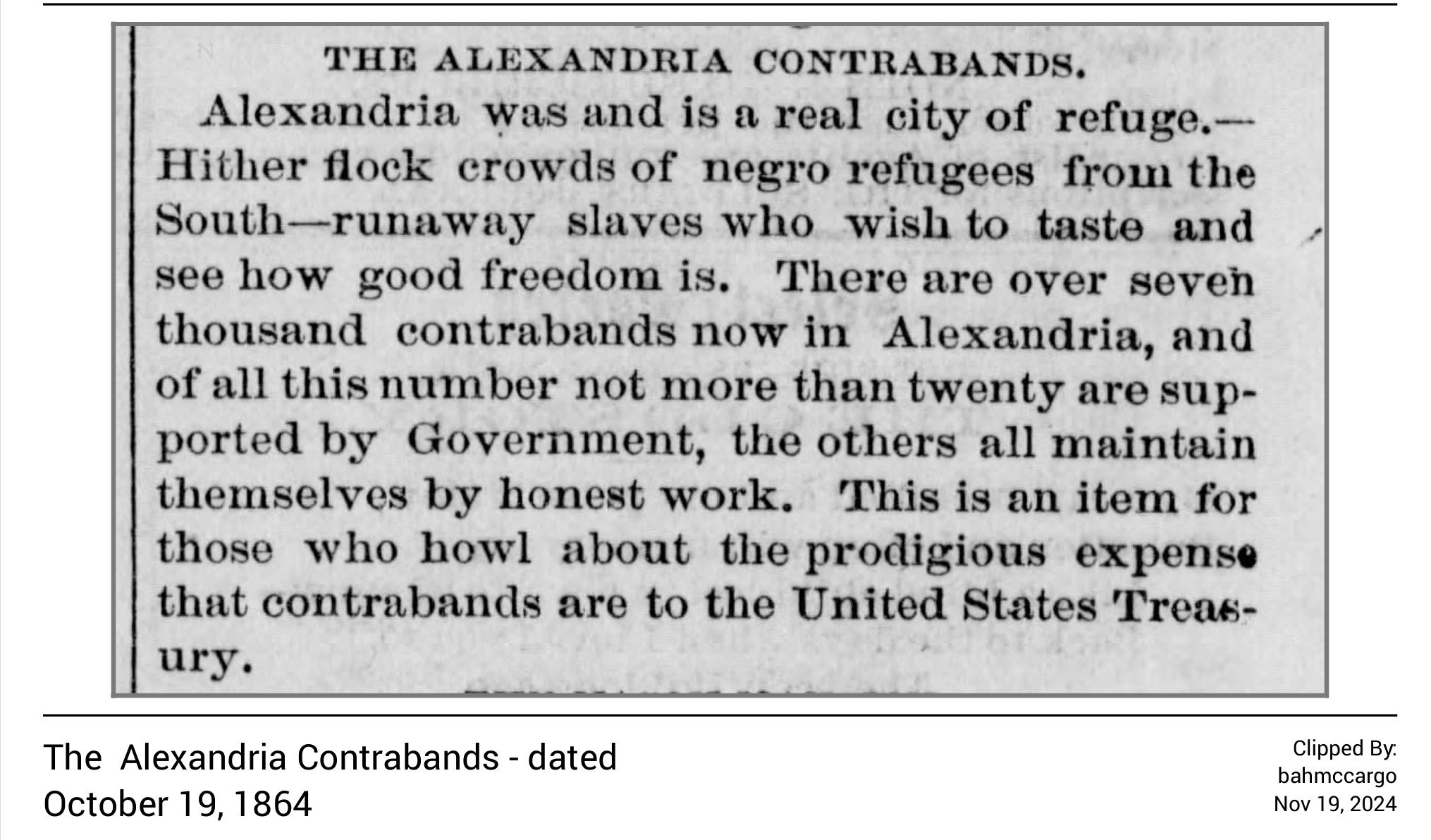
Just like their ancestors, who came to Alexandria for Freedom, Alexandria invited their descendants back to honor their ancestors’ Freedom. But what was the back story of their ancestors? The article on this page, which was published in the “Soldiers’ Journal,” stated that over seven thousand runaway slaves who were called contrabands wanted to taste freedom. They were hardworking people who wanted the same things that other free people had freedom.  

In my book, “Alexandria’s Freedmen’s Cemetery: A Legacy of Freedom,” on page 77, I discuss a child, John Gaines, who was buried at the Freedmen Cemetery in 1864.

“In 1864, the month of July was extremely dry, with the water levels low, grass growing in the reservoir, the temperature very sultry and mosquitoes abounding. During this extremely hot weather, eight-year-old John Gaines was buried on July 28, 1864.”

John Gaines’ parents were among the seven thousand people mentioned in the article who came to Alexandria for Freedom. His descendants, Lillian Locklear Alston and Wanda Ellis took part in the 2014 Freedmen’s Cemetery Memorial Celebration, along with several hundred other descendants of people buried at the Freedmen’s Cemetery.

Everybody’s history is essential; we are the only living thing celebrating our past. If we do not study ourselves or create a study guide of our history and how we came about, then who else will focus on us? For the descendants of the Freedmen Cemetery, they had Alexandria, who gave them the most precious thing a human being can have, which is a piece of their history!

If you want to read additional stories and learn more about the Freedmen Cemetery, you can find the book, “Alexandria’s Freedmen’s Cemetery: A Legacy of Freedom,” by Char McCargo Bah at amazon.com. Also, you can visit Alexandria and stop by the Freedmen Cemetery and the Alexandria Black History Museum.

©2024-Char McCargo Bah

Coming Home—Army -T/5 Julius J. Smith

Julius J. Smith

It was a chilly day on December 7, 1941, in the Northern Virginia area when a Japanese Plane bombed Pearl Harbor. On the following day, the United States (U.S.) declared that they were at war with Japan and Japan’s allies. The U.S. announced a military draft, and many men were drafted; some enlisted, including men from Alexandria. One of those men who enlisted from Alexandria was Julius J. Smith.

Julius was the son of Moses Smith and Hester Carter Smith. On May 29, 1942, Julius married Lillian Virginia Newman. Both were only nineteen years old. Before his marriage, he lived with his parents at 606 South Washington Street, and Lillian lived with her parents at 601 North Pitt Street.  

Julius worked at Leon Baltimore Radio Shop on Washington Street when he was a teenager. The skills he developed at the Radio Shop became helpful in the Military. When he married Lillian, he was working at the Southern Railroad. But his life changed quickly when the call for eligible men to enlist in World War II.

Twenty-nine days after he married, Julius enlisted in the Army in Alexandria on June 30, 1942. He did his basic training in the U.S. While waiting to go overseas, he could visit his wife, daughter, and parents. Julius was not assigned to a particular unit. He was classified as a T/5, which was a Technician Fifth grade. This rank was established in the U.S. Army from 1942 to 1948. The rank was created to recognize enlisted soldiers with exceptional technical skills who were not trained as combat leaders. Julius was one of those specially trained people. In his teens, he worked as a radio repairman and knew the ends and outs of a radio.

Individuals with the T/5 rank were addressed as “corporal,” the same as the corresponding non-commissioned officer at the same pay grade. The technician ranks were removed from the U.S. Army rank system on August 1, 1948.

Julius was sent overseas to France in late 1943. While he was in France, he was directly in the combat areas. Several months into his assignment, he was involved in a fatal trucking accident. He died on July 3, 1945. Julius left his wife, daughter, and his one-year-old son, Linwood Smith, whom he never had a chance to see.

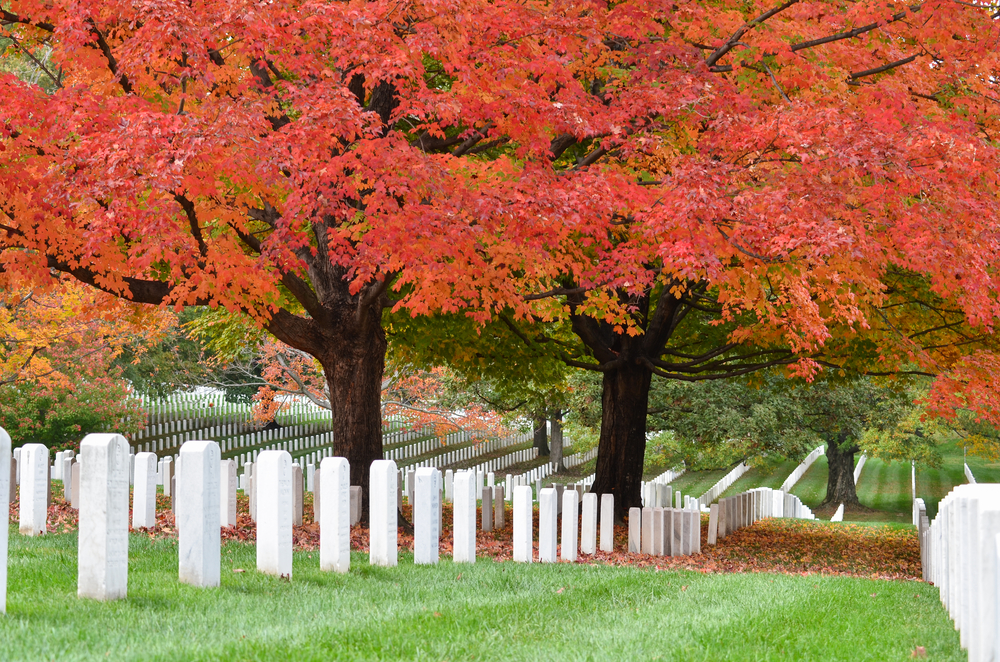
Arlington’s National Cemetery

He was buried in St. Avold Metz, France, but his family petitioned the government to return his remains to the United States. On the Army’s transport, Carroll Victory Ship, on November 18, 1948, sixty-five deceased U.S. Soldiers from the District, Maryland, and Virginia area came home. Julius was one of those soldiers. His coffin was draped with the U.S. Flag and delivered to Alexandria, waiting for his last resting place at Arlington National Cemetery.

On December 15, 1948, over three years after the death of Julius, his family attended his burial ceremony at Arlington National Cemetery. Julius finally came home.

©2024-Char McCargo Bah  

He Made His Mark: Linwood John Henry Newman

It was a cloudy day with rain threatening when the 81-year-old Linwood John Henry Newman died at the Alexandria Hospital on September 9, 1962. Six months before his death, he was diagnosed with bladder cancer. Reflecting on Linwood’s life, he survived the odds and gave his family and grandchildren a middle-class life.

Linwood John Henry Newman on Pendleton Street – 1930s or 1940s

Linwood was a son of a former slave. He was a farmer, a self-employed mason, and a carpenter. He married his first wife, Nannie Daniels, in 1913. They settled on his property in Burke, Virginia, off Braddock Road. He and Nannie had four children: Julius, Elease, Julian, and Grace. By 1919, the couple had divorced. In 1921, Linwood married his second wife, Elizabeth Daniels. They had eight children: Alberta, Lillian, Justine, Marion, Kolan, Herman, Laverne, and Winona.

Linwood was concerned about his children’s education because there were no colored schools nearby. He prepared to move his family to Alexandria around 1926.  He moved his family temporarily to 601 North Pitt Street. He built 510 Pendleton Street and purchased an additional home at 512 Pendleton Street. Linwood used the property at 601 North Pitt Street as his business address. In Alexandria, he found work as a mason, carpenter, and builder. His grandson, Linwood Smith, remembers his grandfather walking to his contract jobs. Some of the jobs he walked to were in Manassas, Virginia. He walked from Pendleton Street to Manassas with a family member pulling a wagon with his tools. Linwood faced hardship during the Depression. He lost his houses at 510 and 512 Pendleton Street. He moved his family to his property on North Pitt Street. After the depression, he was able to buy back his two properties on Pendleton Street. He learned to survive from his father, who was a hard-working man. His father, John Henry Newman, achieved homeownership in 1886 when he purchased nine acres of land on the property where he worked as a slave for Richard Fitzhugh.

Linwood John Henry Newman was born in 1880 on the Ravensworth’s tract in Fairfax, VA. His parents were John Henry Newman and Lillie Nelson Gatewood.

Two of Linwood’s grandchildren, Jesurena and Linwood Smith, live in Old Town, Alexandria. They have fond memories of their grandfather. He left his mark in Alexandria and made his grandchildren proud of his achievements.

(c) 2024 – Char McCargo Bah

The Other Alexandria Is Back!

Starting October 14, 2024, The Other Alexandria Blog will post regularly every two weeks. These posts will be historical pieces on the Alexandria African Americans who helped shape Alexandria into what it is today. So please check out my bi-weekly blogs on The Other Alexandria!

Char McCargo Bah, Author