Déjà vu – Alexandria African American Historic Housing Problems

Some problems never go away, the problem of housing in Alexandria is just one of those big problems. Looking back in time, we can see how these housing problems have impacted so many people especially African Americans and the poor.

In the early 20th century, the United States entered into World War I. By 1940s, the United States entered into World War II. Each of these wars brought more opportunities for the African Americans in Alexandria. The wars increased the demand for workers in the factories, the military, and in the Federal government. Along with these demands were the realization that Alexandria had a serious housing shortage. Many African Americans that were living in the City of Alexandria during this period of time lived in poor housing. Many of these homes were built during the 19th century without inside toilets and running water.

With the Federal Government Housing subsidies, affordable and public housing construction dominated the 1940s in Alexandria. During this construction boom in the 1940s, the country was experiencing “Jim Crow Laws,” which met separate but equal in name only, among the races. In order to build public housing in the African American communities, many of their homes were condemn and demolition.

These African Americans were placed in temporary trailers.
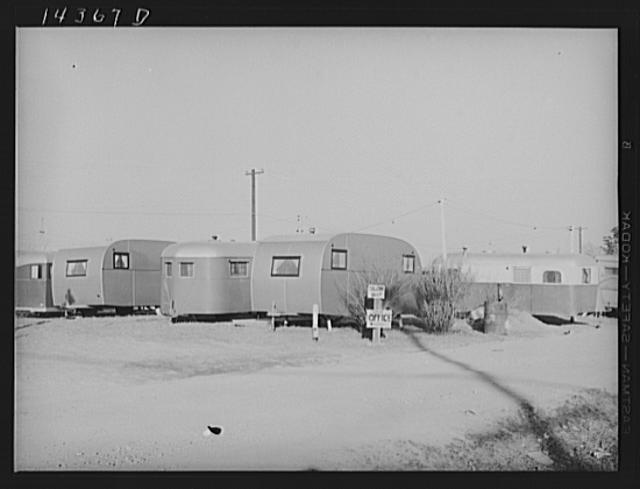
1941 Trailer – Alexandria, VA

A family of six would be placed in two trailers. The parents would be in one trailer and the children would be in another trailer. Some families lived in the trailers between six to fifteen months. The condition that they lived in was horrible. The trailers did not have inside toilets nor showers. Designated trailers were used for showers. Toilet facilities were located in an outhouse building. These facilities were used by everyone who was living in the trailer camp. Parents feared for their children safety, especially for the girls and women.

Memories of this period of time are sketched into the brains of many of the elderly African Americans who lived through this transition period. Their families were put into the trailers until public housing became available.

Two families were interviewed about their life living in the trailer camp. Mr. John Taylor remembers that his dad would not take a shower nor use the bathroom in the trailer camp. “My father would walk to his parents’ house at 214 North Payne Street to shower and use the bathroom. It was really bad in the trailer camp.” Their trailers were on First Street in Alexandria.

Mrs. Charlene Napper, the sister of Mr. John Taylor, remembered that she was a little girl around seven or eight-years-old when they moved to the trailer camp. They had two trailers assigned to them. She also remembered when the family moved out to the newly built public housing at 1005 Madison Street. “Our family did not stay long in public
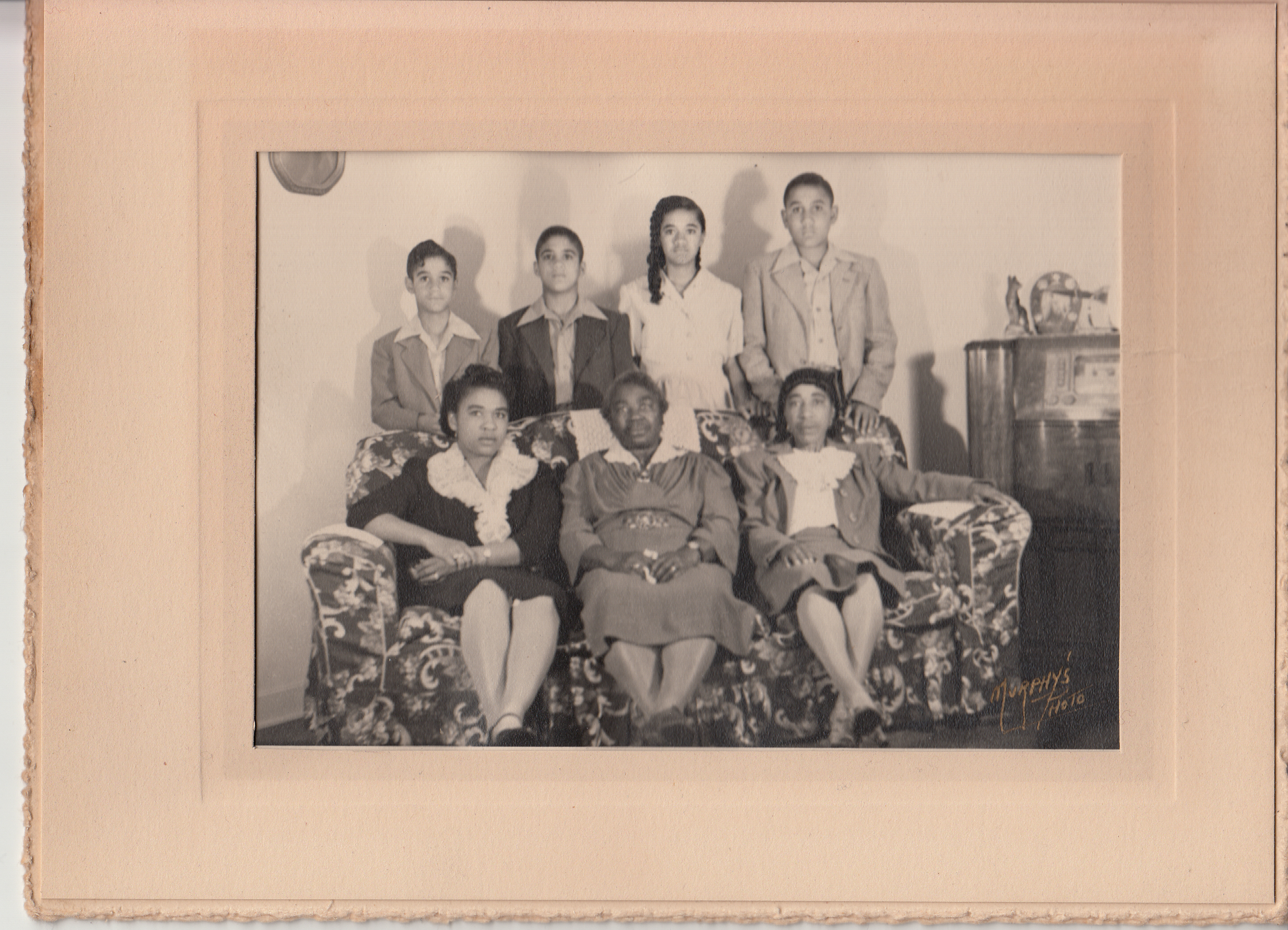
First row: Mrs. Dorothy Knapper-Taylor and her grandmother and her mother – Second roll: Mrs. Dorothy’s children – they all are in the new home on North Payne Street

housing, because my parents were told by the housing authority that my oldest brother would have to move out when he turned eighteen.” Ms. Charlene told me that her father’s employer helped them to purchase a home so that their family could stay together. Today Mrs. Charlene lives in the family home on North Alfred Street. The family has owned this house for seventy-plus years.

Mr. James Beatty’s family also lived in the trailer camps on First Street in Alexandria in the 1940s. Two trailers were assigned to his family as well. After they were relocated to public housing on St. Asaph Street, Mr. Beatty’s father started saving his money and making plans to relocate his family. The opportunities for African Americans to buy their own property in Alexandria was bleak, so Mr. Beatty’s family moved to Washington, DC.

After public housing was built, many African Americans in Alexandria were not eligible for those houses. Their incomes were not low enough to qualify; and, with the segregation laws in place, they couldn’t rent nor buy in the white communities in Alexandria. So, like

Mr. James Beatty

Mr. Beatty’s family, they migrated to Washington, DC and left so many friends and family members behind.

Again, Alexandria is experiencing a demand in housing. And just like the 1940s, again African American families are at risk for affordable housing. But unlike the 1940s, many will not be moving to Washington, DC, because DC has their own shortages of affordable housing.

So, if you live long enough, you will have your Déjà vu moment; and, affordable housing in Alexandria is truly a Déjà vu moment.
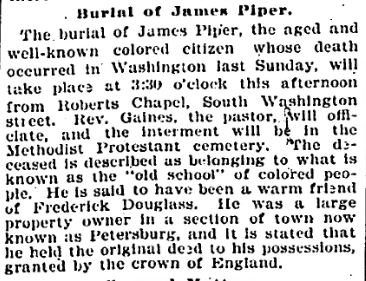
Update – James E. Piper

Mr. James E. Piper's death obit - Tuesday, December 20, 1898, p8 - Evening Star (Washington, DC)
Mr. James E. Piper’s death obit – Tuesday, December 20, 1898, p8 – Evening Star (Washington, DC)

On January 25, 2015, a descendant of the Piper family, Richard contacted me. He has been doing researching his family history for more than a decade.

Though James E. Piper reported in the Southern Claims Commission records that he lost everything he had, Richard said that James owned a lot of real estate up till the time of his death. James continued to operate his brickyard business beyond the Civil War, and expended the business to Leesburg and Loudon Counties in Virginia.

Also Richard provided the information on James’ death. James E. Piper died in Washington, DC on December 17, 1898, while visiting his daughter, Ann Cornelia Piper Gray.

Unfortunately, I do not have any pictures of James E. Piper, but I am glad to know that his descendant is planning on writing the Piper’s family history.

James E Piper

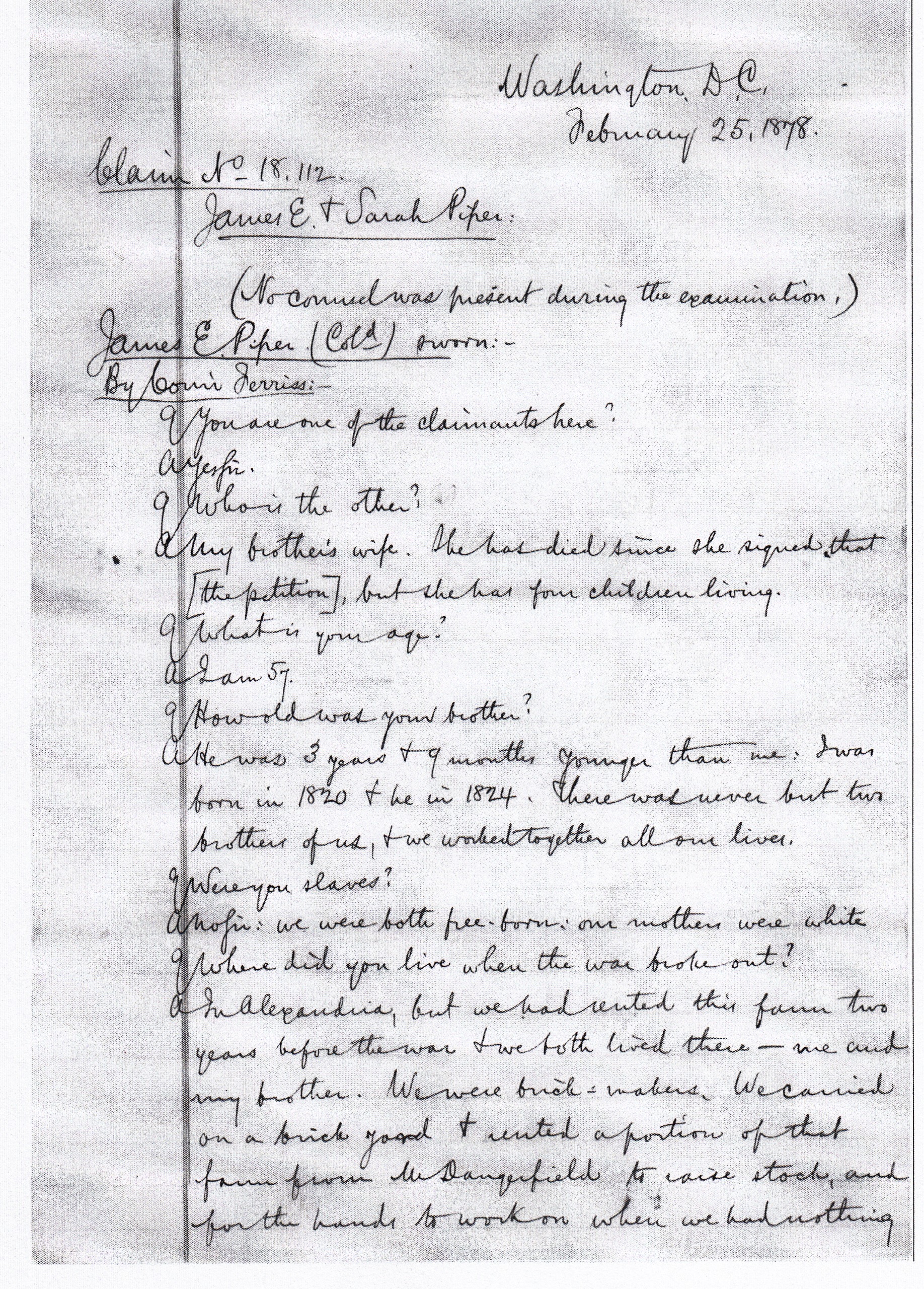
James E Piper's 1878's Southern Claim Deposition
James E Piper’s 1878’s Southern Claim Deposition

The life of Mr. Piper and his losses during the Civil War interested me to the point, I had to tell his story.

James E. Piper (Ramsay) and his brother, William Henry Piper (Ramsay) were freed people of colored prior to the Civil War. They registered in Alexandria County in 1846. James was described as a mulatto man, about 26 years old and 5 feet 3 ½ inches tall. He was born free in 1820. His mother, Elizabeth Ann Piper Ramsay, a white woman, confirmed her son was born free.

William Henry Piper (Ramsay) was also registered in 1846. William was born in 1825 and he was a mulatto man, about 22 years old, 5 feet 5 ½ inches tall. His mother, Elizabeth Ann Piper Ramsay, a white woman, said her son was born free.

James and William and their wives lived in Alexandria, Virginia, but the two brothers leased one-hundred acre farm land from Edward Daingerfield and his wife in the West End, about four miles from Alexandria and a half mile from the Episcopal Seminary. They had leased the land for $75 a year and they had a brickyard and a farm. They had farmed the land for a couple of years prior to the Civil War.

Prior to the Union occupying Alexandria, Edward Daingerfield died. The Piper brothers continued their lease contract with Mrs. Daingerfield.

Around late July of 1861, Blenker’s Brigade camped near the farm after the battle at Bull Run. The Union soldiers seized the farm and ran off the Piper’s employee, James Mitchell. Mr. Mitchell was told by the Union’s soldiers that if he returned to the farm, they will shoot him.

The Piper brothers lost all of their crop, lumber, and animals during the Union’s occupation of the farm. Their property was estimated at $1,306.80. Their inventory of their losses were:

39 hogs
1 stack of hay
7 stacks of oats
30 bushels of rye
160 bushels of wheat
150 bushels of potatoes
1 acre of garden stuff
80 barrels of corn
1 horse wagon
Materials of a stable

James’ younger brother, William died in 1864. James and William’s wife, Sarah, put in a claim to the Federal government after the Civil War for the destruction of their property by Union’s soldiers. They estimated their losses to be $1,306.80. The government only reimbursed the Pipers $183.00. In spite of James’ losses, he swore in front of a government representative that he was faithful to the Union.

Through court cases, southern claims records, censuses, freedmen bureau records, vital statistic records, freedmen registrations, and newspaper articles, I have been able to examine the losses and the accomplishments of the Piper family.

James E. Piper (Ramsay) was married to Ann Elizabeth Brown. They had the following children William, Sarah, Anna, and Thomas.

William Henry Piper (Ramsay) was married to Sarah. They had the following children James H, Elizabeth, Alice G., George, and Frederick.

James E. Piper in 1876 lived at one of his properties at Pitt, corner of Oronoco Street. In 1888, James lived at his property at 427 North Pitt Street. By 1899, James was living at another one of his properties at 423 North Pitt Street. James owned more than three properties prior to 1900.

During James’ lifetime, he witnessed three relatives buried at the Freedmen Cemetery. The relatives were Abraham Lincoln Piper, James Piper, and William Piper. Also James was part of the Trustees of the African American schools prior and after the Civil War. He was an active Republican and he represented District 2 in Alexandria. He served as a juror in the in the late 1860s and in the 1870s.

James also experienced other losses. By 1880, his wife Ann had died. Prior to 1876, his sister-in-law, Sarah also died. In 1880, William’s children and their spouses, George N. Piper, Sarah E Piper Fletcher (Carter), and Alice Piper Landreth (William) sued James for their father’s estate.

On the 1880 census, James was 55 years old and was living alone. His official birth year was 1820. It appeared at that point that his children were no longer living in Alexandria. In 1883, the Alexandria Gazette’s article on Roberts Chapel (now Roberts Memorial Methodist Church) mentioned James’ leadership skills saying, “The choir of Roberts chapel is steadily making progress under the leadership of Mr. James Piper.”

James was not located on the 1900 census, and it is assumed that he might have died between 1883 and 1900.

James and his brother, William should have many descendants. Both of them had children and other Piper relatives that once lived in Alexandria. William’s daughter, Elizabeth married Carter Fletcher on May 1, 1879 at Alfred Street Baptist Church. The famous Reverend Samuel W. Madden officiated their wedding. After their marriage, they migrated to Baltimore, Maryland in the 6th Precinct. They lived on Robert Street. Carter and Elizabeth on 1900 census had four children, Harry, Chester, Alice, and Sarah.
James and his brother, William had experienced financial independence before the Civil War, but lost their farm and brickyard business during the Civil War. His brother died without having the chance to regain any of his property back. On the other hand, James witnessed the emancipation of all African Americans even though he lost his financial independence. By the time the Civil War ended, James was 45 years old. And by the time he settled his claim with the government in 1880, he was 60 years old. The lifestyle and financial freedom he once had was never going to be regained. At his age, he could not regain what he once had.

Celebrating 150 years end of the Civil War

Price and Burch Slave Pen – Duke Street, Alexandria, VA


For 2015, I will be doing a series of articles in celebration of the end of the Civil War. Alexandria African Americans contributed a lot to the growth and history of Alexandria, VA. The forgotten historical contributions of many African Americans in Alexandria have been unknown for far too long. Great accomplishments were made in the 19th Century; but by 1900 many accomplishments were pushed back by Jim Crow laws and segregation. For one whole year, my blog will take you back in time to Alexandria in the 19th Century (1800 – 1899). These articles will focus on the contributions that African Americans made in Alexandria including business, politics, churches, occupations, education, and the continuing fight for their civil rights in the 19th Century. I will start posting these articles twice a month starting on January 11, 2015. If you are not following my Blog, please go to my Blog and sign up to receive notices of upcoming blogs at http://www.theotheralexandria.com. Thanks!