“Importance of Knowing Your History”

The City of Alexandria, Virginia, celebrated the 10th Anniversary of the Freedmen’s Cemetery and its Descendants in a three-day celebration that started on September 6, 2024.

From 2008 to 2014, the City’s Genealogist researched and located descendants of the Freedmen Cemetery. In 2014, the City dedicated the Freedmen Cemetery Memorial, and hundreds of people, along with National Television coverage, brought National recognition to this Cemetery. Before the celebration, many descendants had no clue about their family history related to the Civil War.

Through research, the City gave the descendants a part of their history that they never knew. After they received the news that their family was buried at the Cemetery and that they had arrived in Alexandria after running away from enslavement, they cried as they processed the information. But once they went through that process, their shoulders became straighter, and they knew their ancestors’ strength and determination of wanting freedom at any cost.

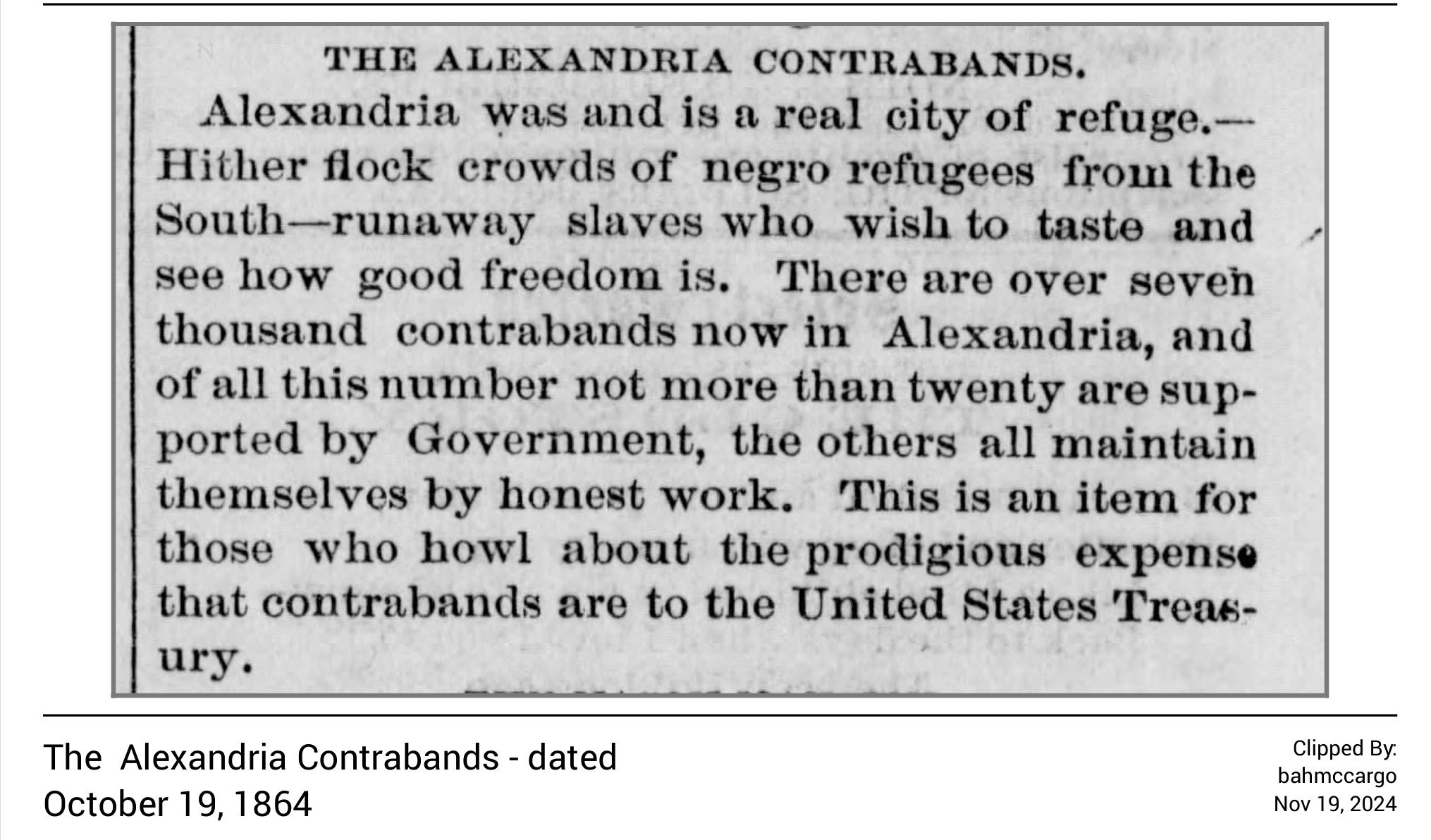
Just like their ancestors, who came to Alexandria for Freedom, Alexandria invited their descendants back to honor their ancestors’ Freedom. But what was the back story of their ancestors? The article on this page, which was published in the “Soldiers’ Journal,” stated that over seven thousand runaway slaves who were called contrabands wanted to taste freedom. They were hardworking people who wanted the same things that other free people had freedom.  

In my book, “Alexandria’s Freedmen’s Cemetery: A Legacy of Freedom,” on page 77, I discuss a child, John Gaines, who was buried at the Freedmen Cemetery in 1864.

“In 1864, the month of July was extremely dry, with the water levels low, grass growing in the reservoir, the temperature very sultry and mosquitoes abounding. During this extremely hot weather, eight-year-old John Gaines was buried on July 28, 1864.”

John Gaines’ parents were among the seven thousand people mentioned in the article who came to Alexandria for Freedom. His descendants, Lillian Locklear Alston and Wanda Ellis took part in the 2014 Freedmen’s Cemetery Memorial Celebration, along with several hundred other descendants of people buried at the Freedmen’s Cemetery.

Everybody’s history is essential; we are the only living thing celebrating our past. If we do not study ourselves or create a study guide of our history and how we came about, then who else will focus on us? For the descendants of the Freedmen Cemetery, they had Alexandria, who gave them the most precious thing a human being can have, which is a piece of their history!

If you want to read additional stories and learn more about the Freedmen Cemetery, you can find the book, “Alexandria’s Freedmen’s Cemetery: A Legacy of Freedom,” by Char McCargo Bah at amazon.com. Also, you can visit Alexandria and stop by the Freedmen Cemetery and the Alexandria Black History Museum.

©2024-Char McCargo Bah

Alexandria World War I African American Veterans

Behind the scene of the Alexandria Gazette story on “Alexandria World War I African American Veterans dated April 19, 2018.

About a month ago, I inquired about information on Alexandria African American World War I Veterans. Amy Bertsch responded to my request and sent me an article on African American World War I Veterans in Alexandria. Thanks Amy!

With the names of these veterans, I was able to research them. For the Alexandria Gazette’s newspaper, I focused on three of the 52 veterans that were drafted. Out of these three veterans, two of them had children: Private Ulysses Garnett Bell and Private Courtney Hauls.

Ulysses G. Bell’s WWI military card

Private Ulysses Garnett Bell was the son of Thornton Bell and Georgianna Brown. Thornton was born around 1840 and his wife, Georgianna was born around 1848. They married 17 September 1874 in Alexandria, Virginia. In 1880, they were living on West Street. Thornton was a laborer for the brickyard. He and his wife had the following children: Edward T. Bell, Mary A. Bell, William H. Bell, Robert Bell, Albert Bell, Silas Bell and Ulysses G. Bell. In 1900 Georgianna Bell was listed as a widow, she and her children were living at 1307 Queen Street. In 1910, Georgianna’s grandson, Charles Henry Bell lived in her household with his mother, Mary E. Bell. Georgianna’s son, Ulysses married Beatrice Brown on 9 March 1914. Beatrice died giving birth to their son, Edward Ulysses on May 6, 1915. Ulysses’ in-laws raised his son, Edward.

In 1917, Ulysses was drafted into World War I. Private Ulysses G. Bell died on 18 December 1945 in Washington, D.C. His son, Edward Ulysses Bell was a World War II Veteran. After serving in the military, he came back to Alexandria. Like his father, he worked for the Federal government at the General Accounting Office. He married Noreen Day and they had one daughter, Beatrice, who was named after Edward’s mother. Edward died on 12 May 2001 in Alexandria, Virginia. His daughter, Beatrice had four children. Two of her children are living today.

Private Courtney Hauls was the son of Cyrus and Sarah Harris Hauls (Halls). Cyrus was born around 1847. He fled his master’s plantation at the age of sixteen; he joined the Colored Troops. He served as Private Cyrus Buckner

Cyrus Hauls (Buckner)
Civil War Veteran

(Hauls) in Company D 118 regiment. The surname Bucker was his alias’ surname. After the Civil War, Cyrus met Sarah Harris. On 13 September 1871, Reverend Fields Cook of Third Baptist married Cyrus and Sarah. The Hauls had the following children: Molly Hauls, Cyrus Hauls, Emily Hauls and Courtney Hauls. By earlier 1900s, Cyrus, Sarah and their children moved to 1010 Wythe Street. Their son, Courtney, married Sarah Tasco in 1909. Courtney’s father, Cyrus died on 13 July 1912. He is buried at Thomas Mann Cemetery (Silver Leaf Association) which is now called the Alexandria African American Heritage Park. Prior to Courtney being drafted, he and his wife had several children. All of their children died but one daughter, Viola Hauls.

Courtney was drafted in 1917. When he returned to Alexandria, his mother and siblings started migrating to New Jersey. Courtney and his wife did not survive his absence during his military duties. His wife deserted him. In 1920, Courtney received his divorce from his wife, Lucy on the grounds of desertion and abandonment. Courtney decided to leave Alexandria first for New York City but later settled in New Jersey. He met his second wife, Viola H. Crawly in New York. They married on 4 November 1926. Courtney and his new wife migrated to New Jersey. Courtney’s daughter, Viola Hauls Brown, from his first marriage, migrated to Orange, New Jersey in the late 1930s. In June 1982, Courtney died in Burlington, New Jersey. Courtney had a son from his second marriage, Herbert Courtney Hauls, Sr. Herbert served in the United States Air Force as a Master Sargent in Korea and Vietnam. He was born in 1928 and he died in New Jersey on 23 February 2000. He is buried at Brigadier General William C. Doyle Memorial Cemetery in New Jersey.