“Importance of Knowing Your History”

The City of Alexandria, Virginia, celebrated the 10th Anniversary of the Freedmen’s Cemetery and its Descendants in a three-day celebration that started on September 6, 2024.

From 2008 to 2014, the City’s Genealogist researched and located descendants of the Freedmen Cemetery. In 2014, the City dedicated the Freedmen Cemetery Memorial, and hundreds of people, along with National Television coverage, brought National recognition to this Cemetery. Before the celebration, many descendants had no clue about their family history related to the Civil War.

Through research, the City gave the descendants a part of their history that they never knew. After they received the news that their family was buried at the Cemetery and that they had arrived in Alexandria after running away from enslavement, they cried as they processed the information. But once they went through that process, their shoulders became straighter, and they knew their ancestors’ strength and determination of wanting freedom at any cost.

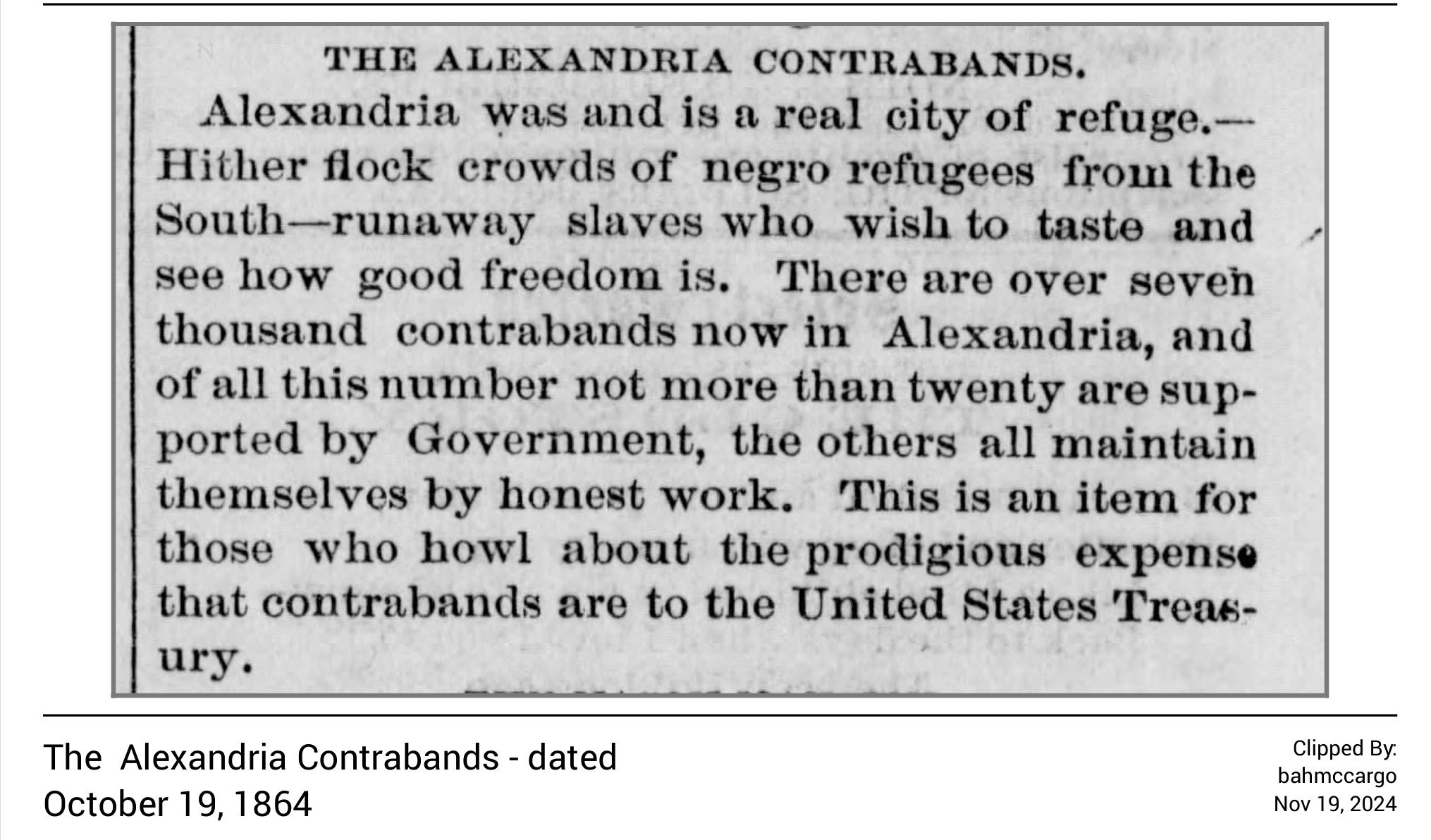
Just like their ancestors, who came to Alexandria for Freedom, Alexandria invited their descendants back to honor their ancestors’ Freedom. But what was the back story of their ancestors? The article on this page, which was published in the “Soldiers’ Journal,” stated that over seven thousand runaway slaves who were called contrabands wanted to taste freedom. They were hardworking people who wanted the same things that other free people had freedom.  

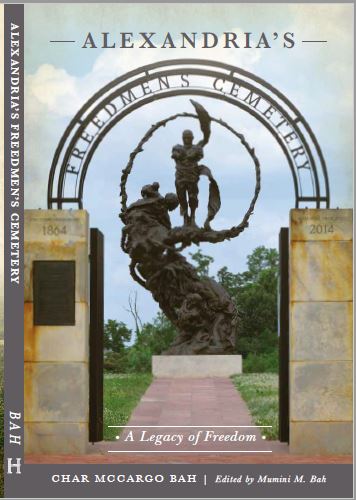
In my book, “Alexandria’s Freedmen’s Cemetery: A Legacy of Freedom,” on page 77, I discuss a child, John Gaines, who was buried at the Freedmen Cemetery in 1864.

“In 1864, the month of July was extremely dry, with the water levels low, grass growing in the reservoir, the temperature very sultry and mosquitoes abounding. During this extremely hot weather, eight-year-old John Gaines was buried on July 28, 1864.”

John Gaines’ parents were among the seven thousand people mentioned in the article who came to Alexandria for Freedom. His descendants, Lillian Locklear Alston and Wanda Ellis took part in the 2014 Freedmen’s Cemetery Memorial Celebration, along with several hundred other descendants of people buried at the Freedmen’s Cemetery.

Everybody’s history is essential; we are the only living thing celebrating our past. If we do not study ourselves or create a study guide of our history and how we came about, then who else will focus on us? For the descendants of the Freedmen Cemetery, they had Alexandria, who gave them the most precious thing a human being can have, which is a piece of their history!

If you want to read additional stories and learn more about the Freedmen Cemetery, you can find the book, “Alexandria’s Freedmen’s Cemetery: A Legacy of Freedom,” by Char McCargo Bah at amazon.com. Also, you can visit Alexandria and stop by the Freedmen Cemetery and the Alexandria Black History Museum.

©2024-Char McCargo Bah

Alexandria’s African American History

If you were visiting Alexandria in the 1950s, you would notice distinct African American neighborhoods like the Berg, Uptown, Hump and so on, but the history of African Americans in Alexandria remained unknown.  Due to the efforts of Lance Mallamo former Director of Office of Historic Alexandria (OHA), Gretchen M. Bulova, Director of OHA, Audrey P. Davis, Director of Alexandria Black History Museum (ABHM) and McArthur Myers, Alexandria 2020 Living Legend/Community Activist, the history and stories of early African Americans in Alexandria have become known.

One of Alexandria’s first national African American projects was the 2014 dedication of the Alexandria Freedmen Cemetery. Hundreds of descendants whose families are buried in the Freedmen Cemetery attended the weeklong events. The former Director of OHA, Lance Mallamo, initiated the weeklong celebration. That event was a turning point for many Alexandria’s African Americans who felt that their history had been forgotten. The event received national-wide coverage from newspapers to television media. Today, the Freedmen Cemetery still attracts tourists as well as Alexandrians. After Mallamo retired, Gretchen M. Bulova was hired in 2019 for Mallamo’s position.

Gretchen and Audrey

Bulova and Davis continue to reveal the rich history of Alexandria African Americans. Some of the projects included the purchase of the “Freedom House”, the former 19th Century Slave Pen from 1828 – 1861. The Freedom House is now a museum. Another one of the City’s projects is the Alexandria African American Heritage Trail that highlights the history of African Americans from the time Alexandria was founded to the 20th Century. In addition, OHA, ABHM and others assisted in getting Earl Lloyd’s Street sign. Earl was an Alexandrian who became the first African American National Basketball Association player.

Under the leadership of Bulova and Davis, the City joined the Equal Justice Initiative to find out whether the City of Alexandria had any history of lynching. Through the committees that OHA formed, they found out that two individuals were lynched in Alexandria. OHA immediately found the financial resources to hire experts to do further research about the two individuals, and to locate their descendants. OHA, some City employees, and the descendants of the lynched victim, Joseph McCoy, and some private citizens traveled in October of 2022 to Alabama. The party carried the soil from Alexandria where the lynching took place in 1897 and 1899 to Alabama. That event also brought national recognition to Alexandria.

Outside of OHA, a dedicated citizen has tirelessly committed his time to identifying historical sites that are associated with African Americans. McArthur Myers retired from the District of Columbia government in 2015. He advocated for fifteen historical signs at sites that are associated with the history of African Americans in Alexandria. His efforts in reclaiming Alexandria African American’s history speaks to volumes about his dedication to the City. He attends City Hall meetings, and he walks the streets of Alexandria identifying sites connected to African American history. Myers is very passionate about the history of Alexandrian African Americans. He, without doubt, is one of the most dedicated advocates for the history of African Americans in Alexandria.

McArthur Myers

Looking at Alexandria today is not the Alexandria that I once knew in my childhood because African American history was absent.  In the 20th Century leading up to the 1970s, the local history of African Americans in the City of Alexandria was not available to the public, nor in the school system. Now, one can walk the streets of Alexandria and see the presence of the history of African Americans of long ago. Although Alexandria looks different in the 21st Century, with old housing communities of the 1930s and 1940s that have been torn down and new ones replaced the old structures, I feel that there are still sites in the City that remind people about the history of African Americans.

Thanks to the City of Alexandria for making efforts that tell the history and stories of their local African Americans who played an important role in the history of Alexandria from the time the City was founded.

Char McCargo Bah is a published author, freelance writer, columnist, independent historian, investigative/genealogist researcher and a Living Legend of Alexandria.

Alexandria’s Freedmen’s Cemetery: A Legacy of Freedom’s Newsletter

Alexandria’s Freedmen’s Cemetery: A Legacy of Freedom (Book Coming Soon)

Alexandria’s Freedmen’s Cemetery: A Legacy of Freedom’s Newsletter

I am glad to announce that my new book will be out between late December and January of 2019. My book “Alexandria’s Freedmen’s Cemetery: A Legacy of Freedom” has been in the making since 2015. I will be posting future book signings and behind the scene journey of finding descendants of the Freedmen Cemetery that is the backbone to writing this book. So look out for the next newsletter in December 2018.


Vote Now! – Deadline to Vote is August 6, 2012


Artist #1 – Mario Chiodo

Three sculpture artists have bidded for the assignment of designing a sculpture for the Freedmen Cemetery. Please view the three artists and vote.

The three Artists finalist are: Mario Chiodo, Oakland, CA; Edward Dwight, Denver, Colorado; and Erik Blome, Crystal Lake, Illinois.

Artist #2 – Edward Dwight


You must let your preference known by August 6 to the committee. The public committee will consider all the comments in making the final choice. The winner for the sculptor will be announced in September.

Artist #3 – Erik Blome

Please send your vote to all three e-mail addresses below. Select one of the three artists above.  Thanks!

Cheryl Anne Colton,
Acting Deputy Director
CherylAnne.Colton@alexandriava.gov or
aca@alexandriava.gov

In addition, to:

Dr. Pamela Cressey
Office of Historic Alexandria/Alexandria Archaeology
Pamela.Cressey@alexandriava.gov